
-
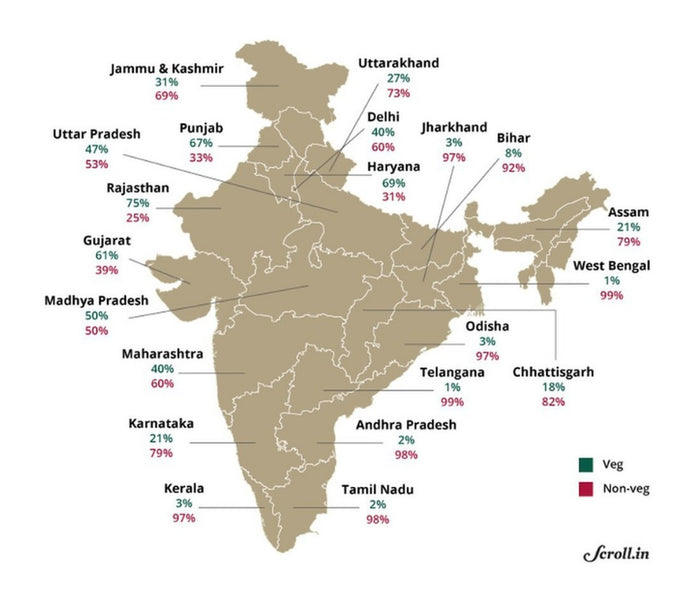
In this overview, you can see the percentage distribution of vegetarians (green) and non-vegetarians (red) in India. Especially in the north, east, and south of the country, the proportion of people who eat meat is significantly higher.
-
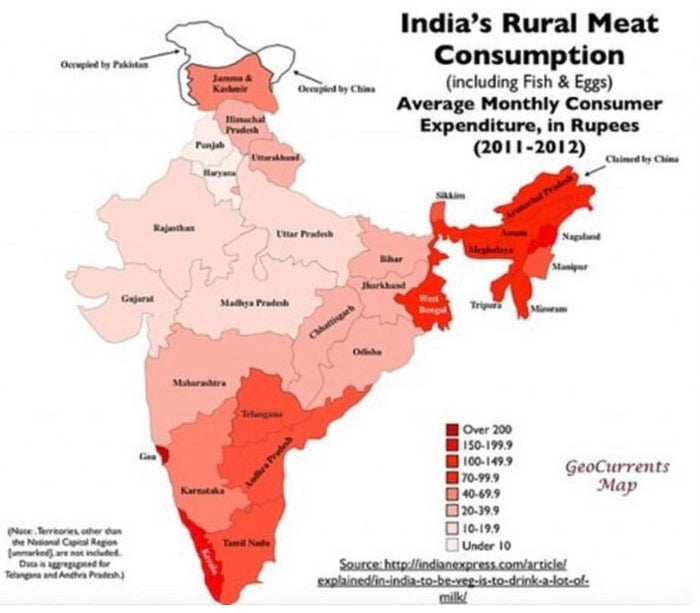
This graphic on the distribution of meat consumption in India illustrates that meat consumption in India is more widespread than previously assumed. The stronger the red, the higher the meat consumption!

Does cattle slaughter really take place in India?
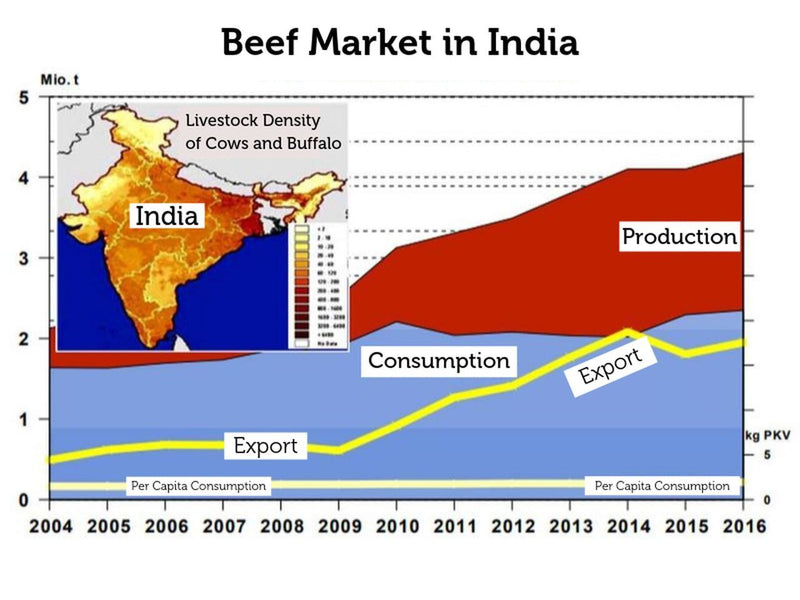
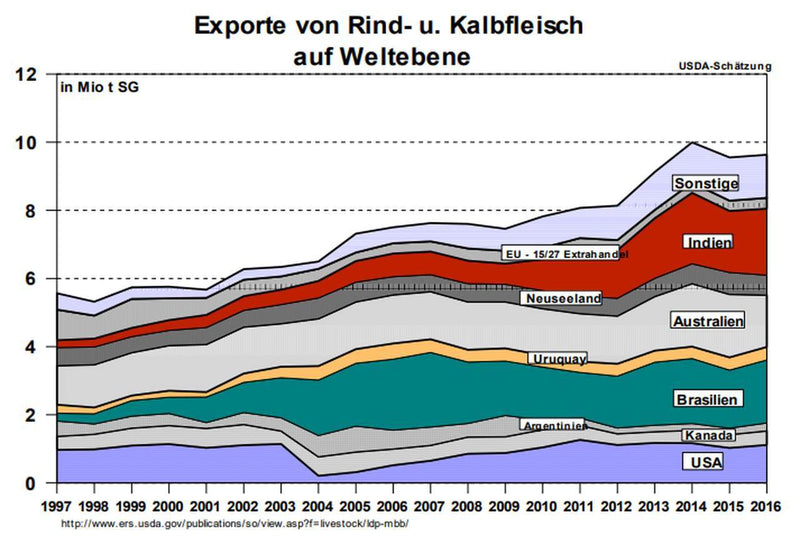
India is now one of the largest beef producers in the world. For comparison: around 8 million tonnes of beef are produced annually in the EU and around 4.3 million tonnes in India. So beef is not only consumed, but also produced on a large scale.
Most of India's slaughterhouses are located in the south (Chennai) and north (Uttar Pradesh and Kolkata). Around half of the meat comes from there for export to Qatar and Saudi Arabia. The slaughter takes place according to the rules of Islam, so the meat is considered “halal”.

Slaughtering: The significance of halal meat
The slaughter of healthy animals is regulated religiously in Islam and Judaism. There are regulations in the Koran and the Torah that no carrion or blood may be consumed because life is seen in blood.
When slaughtering, the carotid arteries, jugular veins, trachea and esophagus are usually severed without prior anesthesia, so that the animal quickly bleeds to death. The procedure is intended to reduce suffering as much as possible.
After slaughter, the meat and organs are checked for health, whereby in Judaism “kosher” and in Islam “halal” is the sign of edibility.
Origin of animal skins for Gusti Leather
PETA films sometimes show extremist cases in which cows are brought to Bangladesh. Such practices affect less than 15% of cowhide production in India.
Most hides are produced and processed locally. In addition, meat and hides are exported partially preserved (salted) from the EU or South America to India to complement the supply chain.
The slaughtering process depends on the meat consumer: export meat is often halal, while in southern India, where many Christians live, meat is consumed in a similar way to Europe.
Source: agrarinfos.de
Slaughter of animals in Europe and South America
In Germany and other countries, animals are only slaughtered by trained specialists in compliance with regulations. The animals are anesthetized so that the higher brain functions are switched off.
Methods include slaughter guns, electrical anesthesia or anesthetic gases to minimize pain. After stunning, the animals are hung up and then bled to death.
Despite regulations, insufficient anesthesia can occasionally occur.
Gusti Leather and animal skins
We from Gusti Leather condemn both slaughter and slaughter, as both processes can cause suffering for the animals. Consuming meat means death for animals, and we support reducing meat consumption and making conscious decisions to consume less meat.
Why do we still use animal skins? Our products are made from by-products of the meat industry. Regardless of whether the animals were slaughtered in India or in the EU - no animal is killed solely for its skin.
A cow weighs 800–1,200 kg; About 85% of it is meat, the rest is skin and bones. Our use of the hides enables responsible processing of this resource without killing additional animals.
Sustainable use of the hides
When producing our leather products, we use hides that are a by-product of the meat industry. Otherwise they would remain unused.
Our leather is therefore predominantly made from existing resources and the processing follows traditional, gentle methods
Our Bestsellers
View all-

 - 11%
- 11% -

 - 24%
- 24% -

 - 6%
- 6% -

 - 25%
- 25% -

 - 27%
- 27% -

 - 36%
- 36% -

 with free engraving
 -

 - 28%
- 28%